How do contractors prevent costly rework by accessing BIM in AR?
In construction, BIM (Building Information Modeling) has become a standard for design and planning. But on site, its potential remains largely underused.
Traditional tools are heavy and require specialized hardware.
Access to IFC models in real time is restricted to workstations.
Discrepancies between design and execution are often detected too late, leading to costly rework that can represent up to 10% of a project’s total cost.
Vertex BIM commissioned 3dverse to explore a new approach: making BIM truly accessible to field teams, directly from their smartphones.
The solution: an AR Overlay prototype powered by 3dverse
We developed an R&D prototype on the cloud-native 3dverse platform.
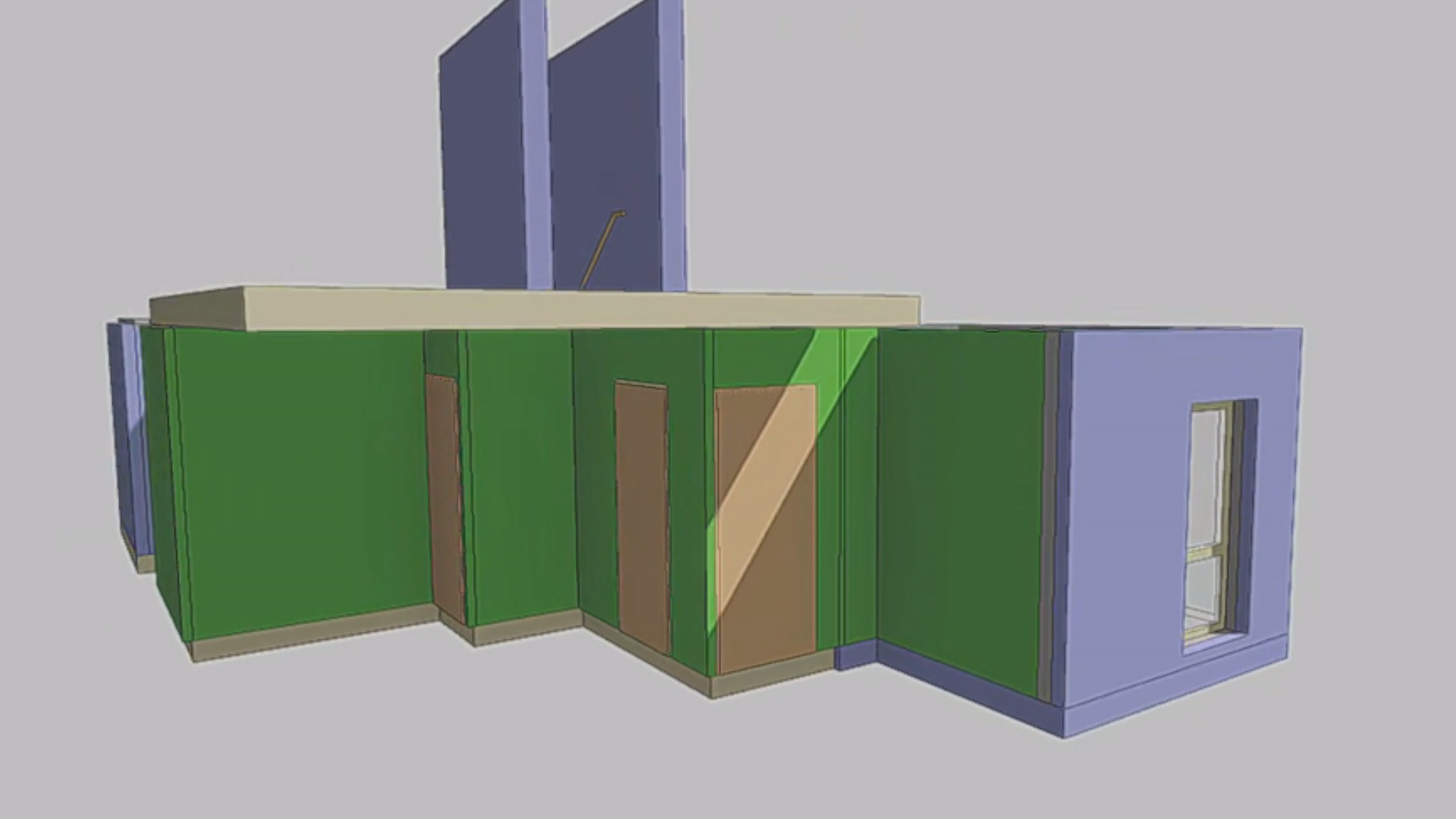
The idea is simple: allow operators to overlay the IFC model on the real construction site in augmented reality, instantly verifying installation compliance.
WebXR: web-based accessibility
Traditionally, deploying AR means developing and maintaining separate native apps (ARKit for iOS, ARCore for Android, proprietary SDKs for XR headsets).
With WebXR, this complexity disappears.
WebXR is a W3C standard API that exposes immersive sensors directly to the browser:
Cameras for real-time vision
LiDAR and infrared sensors for depth and surface detection
Accelerometer and gyroscope for motion and orientation
Result: the user simply opens a URL and activates AR in their mobile browser. No installation. No barriers.
LiveLink + WebXR: real-time cloud-native rendering
The 3dverse LiveLink module ensures cloud-native 3D rendering and AR integration:
The IFC model is rendered in real time, with transparent materials and highlighted edges for better readability.
Frames are streamed to the browser and overlaid onto the smartphone’s camera via WebXR.
Depending on the device:
Smartphone → single-camera rendering
AR/VR headset → stereoscopic rendering (one image per eye)
This architecture enables seamless transition from a digital twin to AR visualization on site—without friction or compilation.
Smart spatial alignment
One of the biggest challenges: precisely anchoring the virtual model in real space.
We implemented a reference-point alignment system:
The user selects a wall corner or intersection in the IFC model.
They locate the same point in reality using the phone’s camera.
A triangulation logic (1 to 3 points, depending on context) adjusts scale and orientation.
Fine-tuning tools (translation/rotation) allow manual correction if needed.
Result: a reliable overlay that highlights discrepancies between plan and reality.
On-site use cases
Instant inconsistency detection: e.g., ensuring plumbing doesn’t block planned electrical routing.
Continuous quality control: checking dimensions and orientations as installation progresses.
Operational support: giving field teams direct, intuitive access to BIM without relying on a dedicated workstation.
Why this is a turning point
This prototype demonstrates a paradigm shift in BIM adoption:
Universal accessibility: a smartphone is enough.
Operational efficiency: instant quality control, fewer office–site back-and-forths.
Tangible savings: discrepancies corrected before costly rework is needed.
Interoperability: thanks to the 3dverse cloud-native infrastructure, the model remains unique, collaborative, and connected.
Conclusion
With Vertex BIM, 3dverse shows that digital twins are not just for design or simulation.
They are becoming operational field tools that transform how construction sites are monitored, coordinated, and delivered.
This is more than a prototype: it’s proof that AR can finally make BIM useful where it matters most—on the job site.